




Your client leaves with something worth exploring. A question that finally made sense. A moment of recognising what they need. A different way to respond.
Then they are back in the situations that made it difficult in the first place.
I AWAKE gives you material, audio and a shared structure for the time between meetings. Choose what fits your work together, give the client a clear place to return to it and bring what they discover into the next conversation.
For practitioners who buy I AWAKE bundles for their clients, access to the practitioner platform remains free. Your clients pay no platform access fee either.

You do not need another folder of exercises that bear little relation to the conversation you just had.
Start with what mattered to this person. Choose a relevant I AWAKE resource, add the question you want them to explore and agree how it connects with your work together. The material and included audio give them something concrete to return to when the session is no longer fresh in their mind.
Perhaps you are working on the difference between choosing to help and feeling unable to disappoint anyone. You might invite the client to notice one moment when that difference appears, then bring their observations to your next meeting. The purpose is clear. The experience is theirs.

The I AWAKE universe connects books, audio, practices, human capacities, a glossary and the Reading Room. Its three bodies of work, The Sensual Hero’s Journey™, The Creative Hero’s Journey™ and The Hidden Hero’s Journey™, offer different starting points for exploring experience.
Discuss the material you want to use with us. We will help you choose a bundle for the people you work with, with a personal quote and clear information about what is included.
You also receive early access to new material before its public release. If your work calls for something more specific, we can discuss custom material in English or Swedish and quote for the scope you need.


A client may need to write something before deciding whether to say it to you.
The practice workspace is designed to keep that distinction intact. Clients can save reflections privately and choose a particular saved version to share. New writing does not automatically become visible to you. They can stop sharing a version as well.
You can respond to what they choose to share. They can keep a shortlist of things to bring to the next session, so an observation from Tuesday need not depend entirely on what they remember on Friday.
Agree together whether you will read or respond between sessions and when. A shared space works best when both people know what to expect.


Once you have put together a useful sequence, you can save it as your own template and adapt it for another client or group. Arrange the material in an order that makes sense and plan when each part appears.
The template gives you a starting point. Your judgment determines what belongs in this person’s work, what needs changing and what should be left out.

For individual work, use a private practice space with material relevant to that client.
For a group, choose whether participants need shared material without a discussion area, or a space where they can contribute and respond. You set the purpose and participation agreements. Participants should know who can see a contribution before they make it.
A workshop group, an ongoing cohort and an individual therapeutic relationship do not need to feel like the same arrangement.

Your work also includes finding a meeting time, changing an appointment and making sure the right person has the right link.
During your introduction, we can discuss the platform’s calendar, individual and group booking, availability, cancellation rules and reminders. We can also walk through the arrangements needed for Google Calendar, Google Meet, Zoom and Stripe payments for your own sessions.
We will confirm which services can be connected for your practice before you rely on them. External provider terms and payment-processing fees are separate from free platform access.
Therapists and counsellors: Explore whether selected I AWAKE material fits the person, your formulation and your treatment approach. Choose the practices and pacing yourself, and agree how you will review what happens between meetings.
Coaches: Connect a resource to a goal the client has chosen. Use the next conversation to explore what they noticed, tried or reconsidered, rather than treating completion as the whole point.
Facilitators: Give participants a shared reference before or after a workshop. Choose a quiet material space or a discussion format to suit the group and the agreements you have made.
Tell us how you work. We will discuss the offer in relation to that, rather than asking you to fit a single way of using it.

Aurora is an optional AI Practice Partner, available by invitation. Her reflective approach helps clients examine a thought, notice bodily experience in context and consider what they want to try in everyday life.
You can request a meeting to explore her approach and discuss access to try her. Aurora’s access and usage terms are arranged separately from the free practitioner platform.

Attention, emotional awareness and the ability to question a thought are not interchangeable. Explore the human capacities that connect the material and find language for the particular aspect you want to work with.

When a term becomes part of your conversation, give the client somewhere to check its meaning. The glossary distinguishes research terminology, everyday expressions and I AWAKE’s own concepts.


The Reading Room lets you and your clients follow a subject beyond the immediate exercise. Explore its nuances and research context, then decide what is relevant to your work together.


If you buy I AWAKE bundles for your clients, your practitioner platform access remains free. There is no recurring platform subscription to keep that access. Your clients have no platform access fee. Purchased materials, your professional fees, custom commissions and external service charges are separate.
Yes. You can organise suitable resources into a sequence, save it as your own template and adapt it for another person or group. We will confirm which I AWAKE material is included in your bundle.
Yes. Tell us about the group, the purpose and whether you need English, Swedish or both. We will discuss a suitable scope and provide a personal quote.
No. That subscription is for a person’s own practice across a Hero’s Journey. This offer supports practitioners using I AWAKE with their clients.

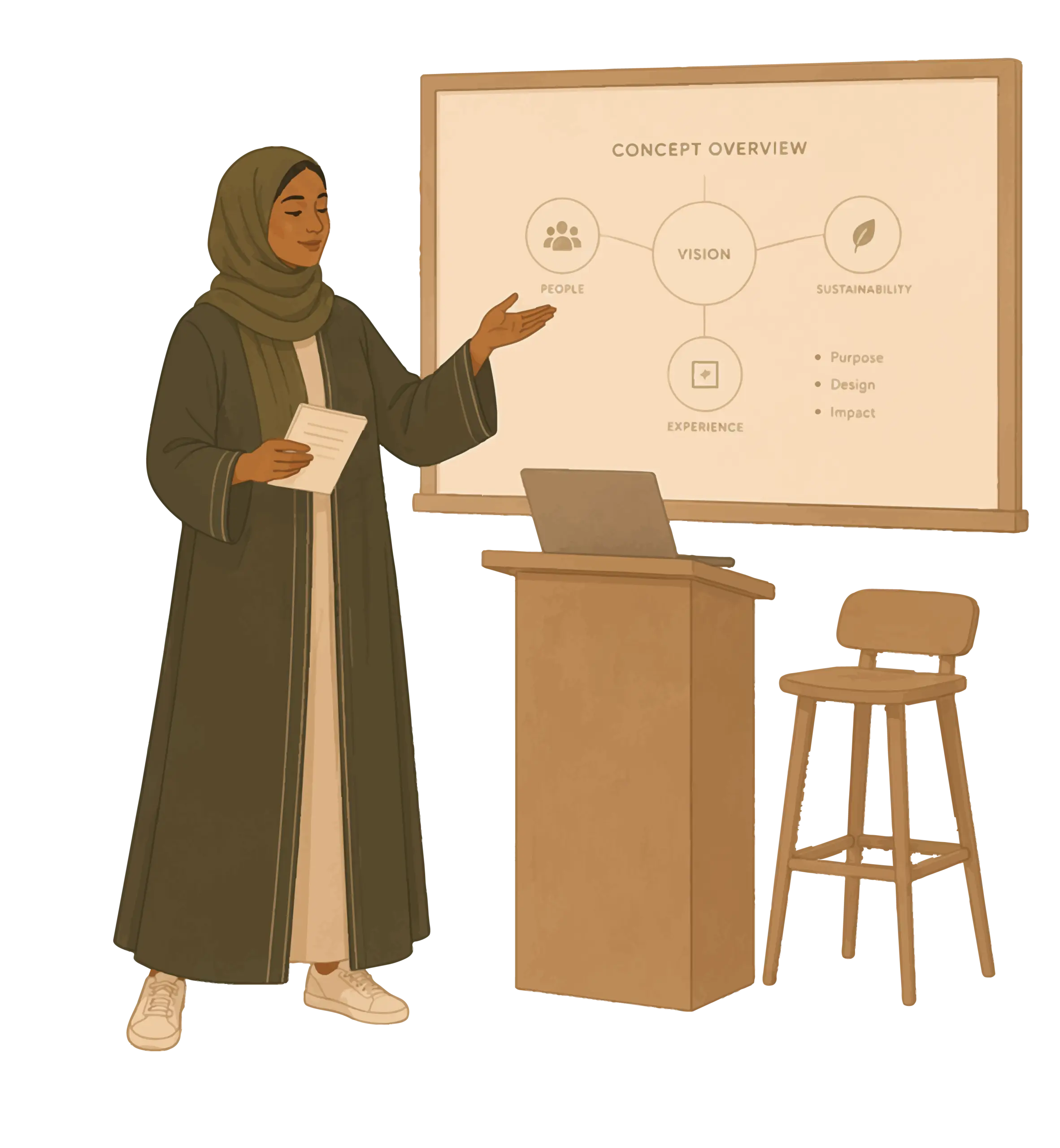
I AWAKE is a human-development universe created by Camilla Wellton. It brings reflective writing, bodily attention, imagination, audio and everyday practice into three connected bodies of work. The Sensual Hero’s Journey™ explores sensation, desire, emotional life and connection. The Creative Hero’s Journey™ explores possibility, permission and capacity. The Hidden Hero’s Journey™ explores perception, interpretation and the inner world.
For your work, that means several ways into a question. A client may recognise something through a passage, an image or a bodily observation before finding words for it. You choose what fits the person and your purpose together.
Research into underlying processes helps inform how the material is designed. That is different from a trial of the I AWAKE system itself. We do not present the whole universe as a clinically validated treatment.
You should be able to distinguish an empirical finding, a theoretical model, a symbolic interpretation and an I AWAKE practice. The research page makes those connections explicit so you can assess the material with your own professional judgment.
Interoception concerns signals from within the body and how they are sensed and processed. Research distinguishes attention to a signal from accuracy in identifying it. I AWAKE invites bodily observation alongside reflection. The useful question is what the person notices in context, rather than what a sensation supposedly proves. Khalsa and colleagues.
Attachment research offers ways to examine closeness, support and responses to relational uncertainty. I AWAKE uses such questions to explore lived relationships, without reducing someone to an attachment label. You might work with how a person asks for help or responds when closeness feels uncertain. A pattern is a subject for inquiry, not a verdict about a partner. Fraley’s review.
Polyvagal theory is an influential, contested model, not a settled account of autonomic physiology. Its specific claims have attracted substantial scientific criticism and responses from its proponents. Where this perspective appears, it should be identified as a theoretical lens. A description such as “I shut down” does not, on its own, identify a particular vagal mechanism. Scientific critique, response.
I AWAKE discusses Jung’s contribution to image work, including active imagination and symbolic inquiry. Jungian concepts belong to a psychological tradition; their presence is not evidence that a symbol has one objectively correct meaning. The material gives you a way to explore an image with the person’s own associations. It is not presented as Jungian analysis. I AWAKE on active imagination, IAAP on analytical psychology.
No. A guided visualisation deliberately shapes an experience through a script. Jungian active imagination has its own history and involves engaging with emergent inner material. The distinction matters when you select a practice: similar use of images does not make two approaches interchangeable. I AWAKE’s discussion.
Sometimes a person notices a sensation before finding a useful description. At other times, a more precise phrase changes what they can explore. Research on affect labelling includes findings from specific laboratory tasks; it does not establish that every reflective writing exercise has the same effect. I AWAKE brings noticing and naming together as opportunities for inquiry. Lieberman and colleagues.
Research on between-session work highlights the relevance of a clear rationale, collaborative planning and review. The practical implication is to connect the activity to something meaningful from the session and return to the experience together. A resource link alone cannot do that work. The practitioner platform provides a structure; you and your client give the practice its purpose. Ryum, Bennion and Kazantzis.
Mental imagery and perception can involve overlapping mechanisms, while remaining different experiences. An imagined scene can therefore be worth exploring without treating it as a recovered fact or an external event. I AWAKE uses imagery as material for reflection; the person’s associations remain open to examination. Pearson and colleagues.
Metacognition concerns how we monitor and evaluate our own thinking. Confidence and accuracy are distinguishable. In practice, that gives you a useful question: what did the person observe, and what did they conclude? I AWAKE’s Reality Literacy work makes room to examine that difference without dismissing the experience itself. Fleming and Lau.
A chosen intention can become more concrete when linked to a recognisable situation: “If I need time before answering, I will ask for it.” Research on implementation intentions examines this kind of planning. It offers a useful connection to I AWAKE’s everyday practice, without guaranteeing that a particular plan will work for every person. Gollwitzer and Sheeran.
Use your knowledge of the person, your professional scope and the work you have agreed. Decide whether inward attention, imagery or written reflection is suitable, and adjust or stop when it is not. The available formats give you choices, not a requirement to use every approach. You can discuss a specific material selection with us before purchasing a bundle.
It is offered as a place for practice material and reflection. It is not presented as a clinical record system. You retain responsibility for your professional records, decisions and agreements about between-session contact. We can discuss the intended use and access arrangements before you introduce it to clients or patients.
The reflection workflow distinguishes private writing from a saved version the client chooses to share. Set expectations together about what you can see, whether you will respond and when. For groups, explain the audience for contributions and agree how participants should handle each other’s information.
The Hero’s Journey provides a narrative way to explore change. The three I AWAKE journeys are creative frameworks, not diagnostic categories or stages every person must pass through. Their value for your work is the question they help the person recognise and explore. Scientific findings should be assessed separately from the narrative that helps make a practice meaningful.


Who do you work with? What would you like your clients to have between meetings? Tell us what you are looking for and we will reply personally with a proposed bundle or an introduction to Aurora, or both.