



A conversation can open something important. Your client knows they want to say no. The next day, someone asks for one more favour and their stomach tightens. The sensation in the body, the expectation in the relationship and the thought “I’m letting them down” arrive together.
I AWAKE gives you language and material for moments like these: the nine books of The Sensual Hero’s Journey™, Reality Revealed with its deck and companion book, and the free Practice platform. You choose what belongs in your work with the person in front of you.

I AWAKE was created by Camilla Wellton. Its research backed themes and practices bring signals from the nervous system, feelings, relationships and inner space into the conversation.
Interoception, attachment theory andJung’s work with symbols and inner imagery are the roots of the I AWAKE material.
Each of the nine books of the Sensual hero’sjourney™ stays close to a particular question, from adaptation and longing to bodily contact, thoughts, feelings and pleasure.
Practice I AWAKE gathers the material you choose and what your client chooses to share before the next conversation.
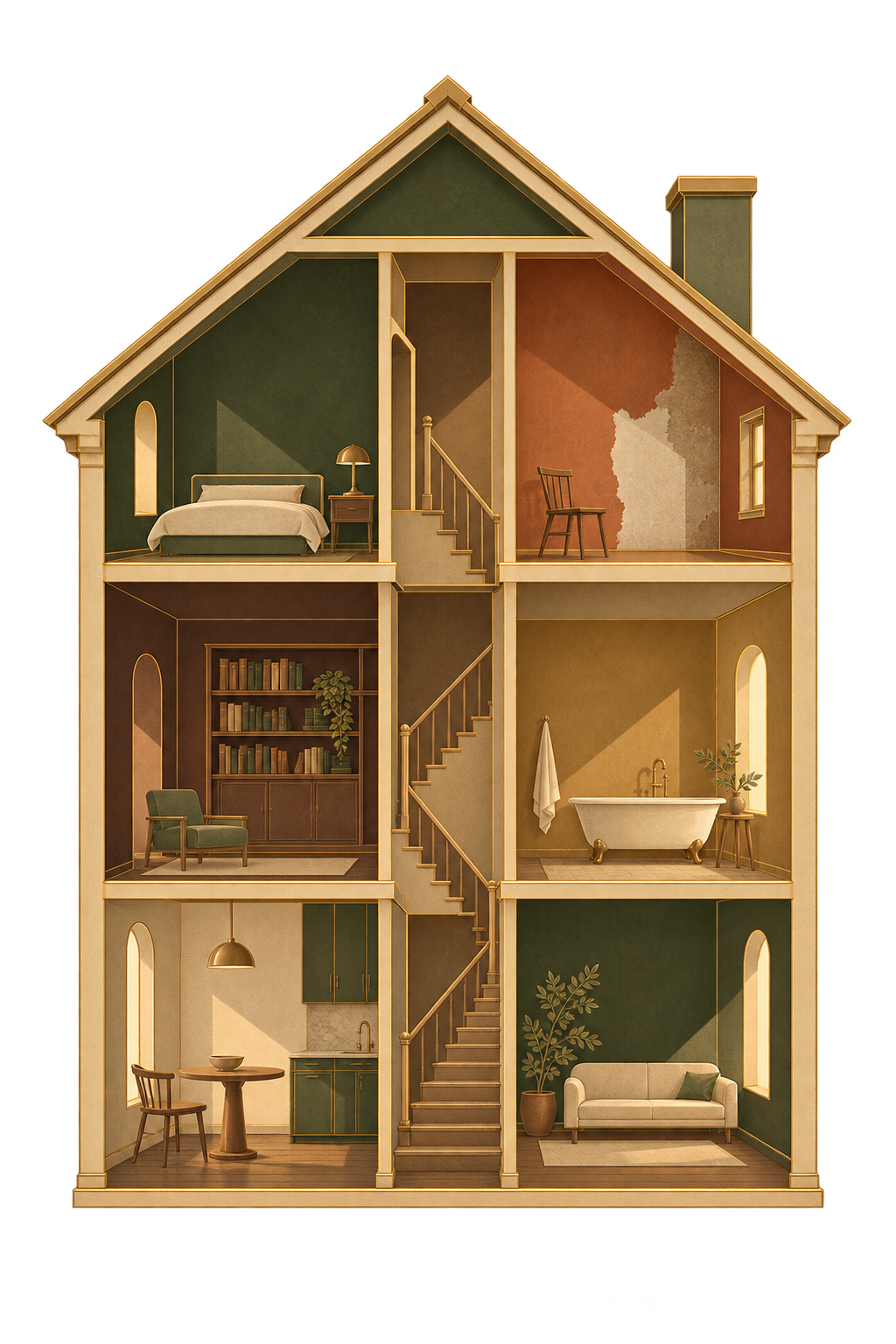
A client says, “I know what I want to say, but my chest tightens.” Interoception concerns how signals from inside the body are perceived and interpreted. Here it becomes a human question: What do you notice in your breathing, jaw or stomach when this situation arises? Read about Interoception.
Attachment research offers language for what closeness, support and uncertainty can stir in a relationship. When someone does not reply to a message, you can explore both the worry and the expectation the silence awakened. Read about Attachment

A systematic review of work between psychotherapy sessions highlights clear purpose, shared planning and follow-up.
Choose a question together, let it travel into everyday life, and return to what the client noticed. Read about giving a practice a place in daily life.
Ask for a personal introduction to Practice and try a seven-day approach. The platform is free for you and your clients, including after the introduction.
If you would rather begin with the books, you can request one Swedish title from The Sensual Hero’s Journey™ as a complimentary EPUB review copy, or all nine as complimentary EPUB review copies on request. These copies are for your own professional assessment; material packages for client use are priced separately.
The SHJ books give words to something that might has been difficult to describe. The guided audio practice of the books brings attention to the body: hands closing, breathing changing, the impulse to answer before the person has had a moment to feel what they want. In a book about closeness, one chapter may open a question about what your client longs for and what their nervous system is preparing for.
When the same theme appears in daily life, the Reality Revealed deck can help you read the moment from several angles. What happened? What was felt? What meaning did it acquire?
Imagine a client agreeing to a meeting when their body was asking for rest. A book may help them recognise the pattern over several days. In a card reading, one text may illuminate the wish to belong, another the role of the person who always makes themselves available.
When your client returns to the book’s practice, they have a moment of their own to read it against. The next conversation can begin with what actually happened.
Choose a recurring question from your work. Gather a text, a practice or your own material in Practice.
See what happens when that question has a clear place between two meetings.
We will help you get started.
The introduction lasts seven days; access to Practice remains free for you and your clients afterward.

Begin with a situation that often returns. Agree with your client on what they would like to notice, then choose material that belongs to that question.
Then ask: What did the person notice? What changed? What would you like to try next? One concrete experience is enough to help you judge whether this way of working adds something.
Would you prefer a personal walkthrough? Mention it in the form and we can begin there together.

You already have methods, material and professional judgement. I AWAKE adds authored journeys that bring together bodily sensation, relational patterns, language and symbolic imagery, alongside a space where you can follow up on what you choose together.
When a client recognises a pattern around boundaries, for example, you might ask: What happens in your body when someone asks something of you? What do you imagine a no would do to the relationship? You can use those questions with your own material or choose a passage and practice from a book to take them further.

Each book has seven chapters, each with its own direction. The days include opening audio guidance, authored text, four recurring reflection questions, a body map and closing audio. For example, after a chapter about boundaries, a reader may mark where their jaw tightened when someone asked for help and write down what they wanted to say.
There is a way back into the journey. The Return practice is there for days when the rhythm breaks. After day seven comes The Circle, an imaginal journey in which an inner place or image meets the body’s response. A longer guided practice can be revisited later. For example, at an imagined threshold, a reader may notice both curiosity and hesitation and carry that observation into everyday life.

The nine books move through three arcs:
Possibility explores old protections and unmet needs; Permission renews contact with body, mind and heart; Capacity asks how what has come alive can find a place in daily life.
Each book holds a constellation of themes and practical investigations but let’s simplify:
Possibility
1. That’s Not Me Who did I become in order to belong?
2. Living on Love Crumbs When you’ve survived on Almost so long, you confuse it with love
3. They Said Time Would… How does an old pattern continue in the present?
Permission
4. I Want to Be Touched What does the body do when closeness comes near?
5. Seduce My Mind When does a thought become an entire reality?
6. Unleash My Heart What happens to feelings I rarely show?
Capacity
7. All of Me How can body, thought and feeling have room together?
8. Pleasure Is My Medicine When does pleasure also nourish me?
9. I Want It All How do I make room for longing and creation in the life I actually live?
As a practitioner, you can request one title as a complimentary EPUB review copy, or all nine as complimentary EPUB review copies on request.
The copies are for your own professional assessment. For client use, we can help you choose a suitable material package.

A client says, “She didn’t answer my message. I knew she was angry.”
The absence of a reply is an observation. The worry is real. The chest may tighten, and the mind may race towards the thought that the relationship is in danger. What the other person feels is still unknown.
Here, a book about relationships can help your client recognise how their body responds when closeness feels uncertain. The deck then helps you explore the step from “this happened” to “this is what it means.” What do we know? What did the person expect? What other reading needs to be considered? Explore attachment in couples’ relationships at Sensual Institute.

“I know I’m allowed to say no. It still feels as though I’m letting them down.” The person understands their right to set a boundary. In the moment, there is also a bodily reaction, an image of who they have usually been, and an expectation of what the other person will feel.
The 78 cards and the Reality Revealed book form a system. Every card has its own authored text; the relationships among those texts can deepen or challenge the first reading. What makes the thought feel so convincing? What is it helping the person protect? What do you need to explore next?

A situation may concern a boundary and, at the same time, belonging, self-image and worry. One card may give language to part of the experience; another may reveal what the first text left out. The companion book gives every card a complete text and shows connections across the deck.
You can follow what resonates and pause at what does not quite fit. Your client can return to the book and its practice with a specific event from their own life. At the next session, you can explore what they noticed. The books offer depth over time; the card system brings precision to the moment.
The physical deck gives the reading a place in the room. The app gives access to card descriptions and a personal journal between meetings.
The nine Circle cards help you explore how a person approaches a question.
What needs a pause, and what wants to move forward?
The 54 Realm cards move through six domains: House, Sky, Garden, Forest, Ocean and Space. They help you see where a question takes shape as the perspective shifts.
The 15 Being cards embody roles and functions. What is a role trying to protect? What does it make possible? Together with Circle and Realm, it finds a place in a larger reading.
I AWAKE Practice is free for you and your clients. You pay no platform fee, and clients pay no fee for their access. Material packages for your practice and your own services are priced separately.
If you charge for your services through your own Stripe account, I AWAKE takes zero commission from your fees. Stripe’s own fees and terms apply.
Yes. You can arrange suitable resources in a sequence, save it as your own template and adapt it for another person or group. We will confirm which I AWAKE material is included in your package.
Yes. Tell us about the group, your purpose and whether you need English, Swedish or both. We will discuss the scope and give you a personal proposal.
The books offer stories and practices to return to. Reality Revealed brings together the deck and companion book. Together, they help you read a lived moment from more than one angle. Practice gives your chosen material and the client’s selected reflection a place between sessions.
Begin with the question you are already working on, then choose the part that adds something there.
I AWAKE is a universe for human development created by Camilla Wellton. Reflective writing, attention to the body, imagination, audio and everyday practice meet in three connected Hero’s Journeys. The Sensual Hero’s Journey™ explores sensation, pleasure, emotional life and contact. The Creative Hero’s Journey™ explores possibility, permission and capacity. The Hidden Hero’s Journey™ explores perception, interpretation and the inner world.
For practitioners, this offers several ways into the same question. Someone may recognise themselves in a passage, an image or a bodily sensation before words arrive. You choose what fits the person and your shared purpose.
I AWAKE has been shaped by questions from research on bodily awareness, emotional language, metacognition and work between sessions. Our research page shows the studies behind these entry points and how they relate to the design of the material.
You can follow the sources, choose what is relevant to your work and make your own professional judgement. Explore the research and sources.
Interoception concerns signals from inside the body and how they are registered and processed. Research distinguishes between paying attention to a signal and identifying it accurately. I AWAKE makes room for bodily observations alongside reflection. The question is what a person notices in context, rather than what a sensation supposedly proves. Read about interoception in the glossary.
Attachment research offers a perspective on closeness, support and reactions when a relationship feels uncertain. I AWAKE uses such questions to explore relationships without reducing a person to an attachment label. You might examine how a client asks for help or responds to uncertain closeness. A pattern can be explored; it is not a verdict on a partner. Read about attachment in the glossary.
Polyvagal theory is influential but contested; it is not an established account of the physiology of the autonomic nervous system. Its specific claims have attracted substantial scientific criticism and responses from proponents. Where this perspective appears, it should be clear that it is a theoretical model. A person saying they “shut down” does not establish a particular mechanism in the vagus nerve. Read about the autonomic nervous system.
I AWAKE discusses Jung’s contribution to work with inner imagery, including active imagination and symbolic exploration. Jungian concepts belong to a psychological tradition; they do not establish one objectively correct meaning for a symbol. The material invites you to explore an image through the person’s own associations. It is not presented as Jungian analysis. I AWAKE on active imagination; Carl Jung in the glossary.
No. Guided visualisation deliberately shapes an experience through a script. Jung’s active imagination has its own history and involves exploring inner material as it unfolds. The distinction matters when choosing a practice. Two approaches do not become interchangeable because both use images. Read the I AWAKE explanation.
Sometimes a person notices a sensation before they have words for it. Sometimes a more precise phrase gives them something new to explore. Research on putting feelings into words includes findings from particular laboratory tasks; it does not show that every writing exercise has the same effect. I AWAKE lets observation and language both contribute to the inquiry. Read how I AWAKE explains research on emotional language.
Research on between-session work highlights clear purpose, shared planning and follow-up. I AWAKE on practices that travel into daily life.
In practice, this means connecting the exercise to something important from the session and returning to the experience together.
A link to material cannot do that work for you. The platform provides structure. You and your client give the practice its purpose.
Inner images and sensory perception can involve overlapping mechanisms, but they remain different experiences. An imagined scene can be worth exploring without treating it as a recovered fact or an external event. I AWAKE uses images as material for reflection. The person’s associations can still be tested and questioned. Mental imagery in the glossary.
Metacognition concerns how we monitor and assess our own thinking. Certainty and accuracy are different things. That offers a useful question: What did the person notice, and what conclusion did they draw? I AWAKE’s work with Reality Literacy lets you explore that distinction without dismissing the experience itself. Metacognition in the glossary.
An intention can become more concrete when it is linked to a recognisable situation: “If I need time before I answer, I will ask for it.” Research on implementation intentions explores this kind of planning. It offers a useful connection to I AWAKE’s everyday practices, without guaranteeing that any one plan will work for everyone. Read how I AWAKE explains plans that can be tried in daily life.
Begin with the person, your professional competence and what you have agreed together. Consider whether inward attention, imagery or writing fits. Adapt or stop when needed. The formats give you options, not a requirement to use every approach. You can discuss a selection with us before buying a package.
It is offered as a place for practice material and reflection, not as a clinical record system. You remain responsible for your professional documentation, assessments and agreements about contact between sessions. We can talk through use and access before you introduce the platform to clients or patients.
The reflection setup distinguishes private writing from a saved version the client chooses to share. Discuss what you can see, whether you will reply and when. In a group, participants need to know who can see a post and how to handle one another’s information.
Hero’s Journey provides a narrative form for exploring change. The three I AWAKE journeys are creative frameworks, not diagnoses or stages everyone must pass through. Their value in your work lies in the question the form helps a person recognise and explore. Research findings still need to be considered on their own terms, even when a story makes a practice meaningful.
Practice gives you a space for the material and follow-up you choose in your work with clients or groups.
Bring together a book passage, a guided audio practice, a question of your own or a sequence of material.
You begin with your method and professional judgement.
Your client has a clear place to return to between sessions.
Practice is free for both of you; your usual professional records continue as before.
Sometimes a client needs to find words for something before they know whether they want to say it aloud. In Practice, they can write privately and choose a saved version to share with you. Later writing does not become visible automatically, and an earlier share can be withdrawn.
Agree on what you will read, whether you will reply between meetings and when your client can expect a response, if any.
We share the Swedish Institute of Inner Technology’s principles on ethics and boundaries.
For one person, you can create a private space with relevant material. For a group, you can choose shared material, with or without conversation among participants.
Make the purpose and sharing arrangements clear from the start, so everyone knows who can see what they write.
Practice is free for you and your clients. You set the price of your own sessions and services.
If you choose to take payment through Practice, you use your own Stripe account. I AWAKE takes zero commission from your fees. Stripe’s own fees apply. You can also explore the calendar, booking and session-planning tools during your introduction.
Choose a question together that belongs to the conversation. Give it a manageable step before the next meeting: a text, a practice or something to notice.
Place your own questions and resources alongside the I AWAKE material you choose. For a particular group, we can also discuss custom-written content in English or Swedish, with a clear proposal for scope and price.
Return to what the client chooses to share: an observation, a question, a moment that went differently. It gives the next conversation a concrete place to begin.
I AWAKE describes more than 30 human capacities. They can help you articulate what a person wants to develop and choose a question to explore together.
When a word matters in the conversation, you should be able to explore what each of you means by it. The glossary explains concepts from interoception, attachment and nervous-system research in human language, while distinguishing them from I AWAKE’s own terms. For example, feeling your heart beat is an observation; what that signal means needs to be understood in context.
The Reading Room gives more space to feelings, relationships and inner experience. Read on your own, or choose a text to bring into your next conversation.
Choose a question from your work. Try Practice with personal guidance, read one of the nine Swedish books as a complimentary EPUB review copy, or explore the deck and Reality Revealed.
Tell us briefly what you are looking for. We reply personally, usually within two working days.

Welcome to the I AWAKE universe. I'm Dawn and I'm your personal concierge. Ask me anything and I'll do my best to guide you in this space.